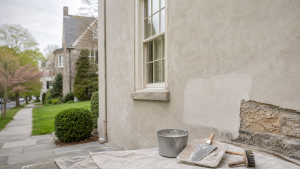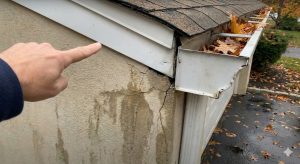

What Is Stucco? A Contractor’s Complete Explanation
Stucco is a cement-based plaster applied over a building’s exterior in layers. That definition is accurate but incomplete — because the word covers three fundamentally different wall systems that look nearly identical from the street and behave nothing alike.
Stucco is a cement-based plaster applied to the exterior of a building in multiple layers, where it hardens into a continuous, jointless surface. It has been used on buildings for thousands of years and remains one of the most common exterior finishes in New Jersey and Pennsylvania.
The complication is that “stucco” in 2026 describes at least three different cladding systems. They share a similar appearance and a similar name. They are built differently, insulate differently, fail differently, and need different repairs. Most confusion about stucco — including most bad advice about it — comes from treating them as one material.
This guide explains what stucco is, what distinguishes each system, and how a stucco wall handles water. If you’re weighing stucco against vinyl, fiber cement or wood for your home, that comparison lives in our stucco siding guide instead.
Stucco Definition and Meaning
The working stucco definition is an exterior plaster made primarily from Portland cement, sand, lime and water. It is applied wet, in layers, over a prepared wall surface, and cures into a hard mineral coating bonded to the structure beneath it.
The stucco meaning behind the word is worth knowing, because it describes the material better than most technical definitions do. It comes from Italian stucco, derived from Germanic roots meaning “crust” or “covering.” That is exactly what it is — a crust. It is not a panel, a board or a plank. It has no seams, no laps and no fasteners, which gives it its characteristic monolithic look and also makes it behave unlike every other common cladding material.
Two properties follow from that and explain most of what stucco does well and badly. It is continuous, so there are no gaps for fire or pests to travel through. And it is rigid and mineral, so it does not flex with a moving building — it cracks instead.
What Stucco Is Made Of
Every stucco material, whether cement-based or acrylic, starts from the same small set of ingredients. Traditional stucco has four, and each does a specific job:
- Portland cement — the binder. Provides compressive strength and hardness as it cures.
- Sand — the aggregate. Gives the mix body, controls shrinkage during curing, and determines the final texture.
- Lime — the workability agent. Makes the wet mix plastic enough to apply by hand, and adds a small degree of flexibility and self-healing to hairline cracks in the cured material.
- Water — triggers hydration of the cement. The water-to-cement ratio has a direct effect on final strength.
Modern acrylic finish coats replace some or all of the cement binder with acrylic polymers. That changes the material meaningfully: acrylic finishes are more flexible and more resistant to hairline cracking, hold color better over time, and are less permeable to water vapor. That last property matters — a wall that cannot dry outward has to dry inward, or not at all.
If you are looking at a house built before roughly 1980, the finish coat is almost certainly cement-based. If it was built or re-clad after that, it may well be acrylic over a cement basecoat, or acrylic over foam. All three are called stucco.
Types of Stucco: The Three Systems in Use Today
This is the distinction that matters most, and the one most homeowners have never had explained to them. When people ask about types of stucco, they usually expect an answer about texture or colour. The types that actually matter are structural — and what separates them is not the finish you can see, but what sits behind it.
Traditional hard-coat stucco
Cement plaster applied in three coats — scratch, brown and finish — over metal lath fastened through a weather-resistant barrier to the sheathing. The oldest of the three systems and still the most common on older NJ and PA homes. Hard, impact-resistant, and rated for decades of service. It is also heavy, rigid, and offers essentially no insulation value on its own.
EIFS (Exterior Insulation and Finish System)
Often called “synthetic stucco.” Rigid foam insulation board is adhered or fastened to the sheathing, covered with a fiberglass-mesh-reinforced basecoat, then finished with acrylic. EIFS adds continuous insulation across the wall, which no other stucco system does. It is also the lightest and the most vulnerable to impact — foam dents where cement would not.
Modern EIFS assemblies include a drainage plane behind the foam. Early barrier-type EIFS installations, common in the 1980s and 1990s, did not, and are the source of the material’s difficult reputation. Our EIFS vs traditional stucco comparison covers this in depth.
Cement board stucco
A hybrid. Fiber cement board replaces both the foam and the metal lath as the substrate, and receives a basecoat and acrylic finish. It gives you the impact resistance of a rigid mineral substrate with the finish flexibility and colour range of acrylic. Frequently specified for commercial buildings and for high-exposure areas on homes. Detail on this system is in our cement board stucco guide.
| Traditional hard coat | EIFS | Cement board | |
|---|---|---|---|
| Substrate | Metal lath over WRB | Rigid foam (EPS) | Fiber cement board |
| Finish coat | Cement or acrylic | Acrylic | Acrylic |
| Adds insulation | No | Yes — continuous | Minimal |
| Impact resistance | High | Low | High |
| Crack resistance | Moderate | High | High |
| Weight on structure | Heavy | Light | Moderate |
Press firmly on the wall with your thumb, somewhere inconspicuous. Hard coat and cement board feel like stone and don’t move at all. EIFS gives very slightly and sounds hollow when you tap it — you’re feeling foam underneath. If you’re still unsure, look at an exposed edge at a window return or where the wall meets a soffit. You can usually see the substrate there. This matters because the right repair for one system is the wrong repair for another.
How a Stucco Wall Actually Works
Here is the single most misunderstood thing about stucco: it is not a waterproof layer. It was never designed to be one.
Cement-based stucco is porous. It absorbs water during a rain event, holds it, and releases it as the wall dries. Building scientists call this a reservoir cladding. The stucco is not the waterproofing — it is the outer layer of a system in which something else does that job.
That something else is the weather-resistant barrier (WRB) behind the lath, together with the flashing at every point where the wall is interrupted. Windows, doors, roof-to-wall junctions, deck ledgers, vents, hose bibs — every one of these is a hole in an otherwise continuous surface, and every one needs flashing that directs water back out.
So a functioning stucco wall does three things in sequence: the stucco sheds most of the water and absorbs some; the WRB stops whatever gets past the stucco; and the flashing and drainage plane route that water back to the exterior before it reaches the sheathing.
When a stucco wall leaks, the stucco is rarely the failure. The failure is almost always at a transition — a window head, a kickout at a roof junction, a penetration whose sealant has aged out. This is why sealing or repainting the surface does not stop a leak that originates at a flashing detail. We cover the diagnostic logic here.
Why Stucco Behaves Differently in NJ and PA
Stucco performs differently by climate, and the Mid-Atlantic is a demanding one for it. Two regional factors do most of the work:
Freeze-thaw cycling. New Jersey and eastern Pennsylvania go through roughly 90 to 110 freeze-thaw cycles in an average year. Water that has been absorbed into porous stucco, or that sits in a hairline crack, expands as it freezes. Repeated often enough, this widens cracks that started small and spalls material at the edges. A crack that appears in autumn is typically wider by March.
Rainfall volume. The region gets over 45 inches of precipitation annually, well distributed across the year, plus periodic nor’easters that drive rain horizontally against walls rather than down them. Wind-driven rain finds transitions that vertical rain never tests.
The practical consequence for homeowners here is that perimeter sealant and flashing maintenance carries more weight than it would in a dry climate. It is not optional upkeep on a Mid-Atlantic stucco home. Our seasonal maintenance guide covers what to check and when.
The Four Ways Stucco Fails
Almost every stucco problem traces to one of four mechanisms. Knowing which one you’re looking at determines whether you’re facing a cosmetic repair or a structural one.
- Moisture intrusion at transitions. Water enters at a failed flashing or sealant joint and reaches the sheathing. The most serious failure mode and the least visible — sheathing can rot substantially while the exterior looks sound.
- Structural movement. Foundation settlement, framing shrinkage or seasonal soil movement flexes a wall that cannot flex. Result: diagonal cracks, typically radiating from window and door corners.
- Installation error. Insufficient cure time between coats, wrong mix proportions, missing control joints, lath fastened without the WRB properly lapped. These problems appear within the first few years and are not maintenance issues.
- Age and weathering. Sealants harden and shrink. Finish coats chalk and fade under UV. Hairline crazing appears. This is normal, expected, and manageable — it is the category most homeowners assume all stucco damage falls into, and the only one that genuinely does resolve with surface work.
Cracks are the visible symptom in three of these four categories, which is why crack width and pattern are diagnostic rather than decorative details. Our crack repair guide covers how to read them.
The surface you can see is the least important part of a stucco wall. The barrier behind the lath and the flashing at every opening decide whether the wall lasts fifty years or ten. A perfect finish coat over inadequate flashing is a problem waiting to be found. Sound flashing under an ordinary finish coat will outlast everything around it.
Where to Go From Here
“What is stucco” is the starting question. Which one comes next depends on your situation:
Frequently Asked Questions
Originally from Poland, Kamil spent years mastering stucco and exterior finishing before founding JARART LLC in New Jersey. Over a decade of NJ and PA projects — from Mercer County residences to commercial work for Marriott and Hyatt and the BAPS Swaminarayan Akshardham Temple in Robbinsville, NJ, the largest Hindu temple in the USA. JARART LLC works with Senergy-Sika, Dryvit, Sto, Sherwin-Williams, Behr, Pecora and Benjamin Moore materials.