Buying a Stucco Home in NJ: What to Check Before You Offer
Stucco on a listing is not a reason to walk away. It is a reason to look harder before you commit — because the failure mode that matters is invisible from the curb, and standard home inspections are not designed to find it.
Before you make an offer on a stucco home, establish three things: what system is on the house, whether there is visible evidence of water entry, and whether the exterior details that keep water out are actually present. If any of the three raises a question, order a stucco-specific moisture inspection before your due diligence period closes — not after.
That last point is the one buyers get wrong. A stucco home inspection and a standard home inspection are not the same thing — the standard one is a visual survey. It is not designed to detect moisture behind a cladding system, and a competent home inspector will tell you so. On a stucco house, the absence of findings in a general inspection is not evidence that the wall is sound.
Step One: Find Out Which System You’re Looking At
Three different claddings get called stucco, and your risk profile depends heavily on which one is on the house.
Traditional hard-coat stucco — cement plaster over metal lath. Rigid, hard to the touch, no give at all. Long track record, well understood, repairable.
EIFS (“synthetic stucco”) — acrylic finish over rigid foam insulation. Gives very slightly under thumb pressure and sounds hollow when tapped. This is where the age question becomes important.
Cement board stucco — finish over fiber cement board. Feels rigid like hard coat but is a newer system.
Early EIFS was face-sealed, or “barrier,” design — intended to be watertight at the surface with no drainage path behind it. Building Science Corporation describes face-sealed EIFS as inherently defective and unfit for use where moisture-sensitive components sit behind it without provision for drainage, and the National Association of Home Builders has taken a comparable position. Drainable EIFS was introduced in the mid-1990s specifically to fix this, and the industry association recommended the switch for residential construction in 1998. In practical terms: EIFS on a house built before the late 1990s warrants a moisture inspection. EIFS installed after that is likely a drainage system, and drainage EIFS performs well when detailed correctly.
Step Two: The Walk-Around
You can do this yourself at a showing, without tools. Walk the full perimeter slowly, then repeat it looking upward. Any single item below justifies a closer look. Two or more together should mean a professional inspection before you proceed.
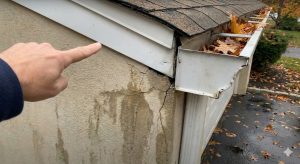
- Dark vertical streaks below window corners. Sometimes called stucco tears. They indicate water repeatedly escaping from behind the window frame — failed sealant, missing head flashing, or both. This is the most common entry point on NJ homes and the most commonly ignored sign.
- Missing kickout flashing. Look where a roof edge terminates against a wall that continues past it. There should be a piece of flashing there diverting water into the gutter instead of behind the stucco. Its absence is one of the most consequential defects on a stucco house, and it is visible from the ground if you know to look up.
- Concentrated algae or moss. General weathering is normal. Green patches in one specific area — under a windowsill, at grade, below a roofline — mean that section stays wet when the rest of the wall dries.
- Cracks wider than a credit card. Fine crazing is age. A crack you can slide a card into is a path for water. Diagonal cracks running from window and door corners suggest structural movement rather than surface ageing.
- Stucco buried at grade. The base of the wall needs clearance above soil and mulch. Where the stucco disappears into the ground, it is wicking moisture continuously.
- Bulging, soft spots or a hollow sound. On any system, an area that flexes or sounds different from the wall around it indicates something has failed behind the surface.
- Sealant condition at every opening. Look at the joint where stucco meets window and door frames. Hardened, cracked or separated sealant means that joint has been open to water for some time.
If you can, visit the property once during or just after rain. A wall that is drying evenly looks uniform. A wall with a problem shows you exactly where — one section stays dark long after the rest has lightened, or you see water tracking from a specific point. Twenty minutes in the rain tells you more than an hour on a dry day.
Step Three: Decide Whether You Need Invasive Testing
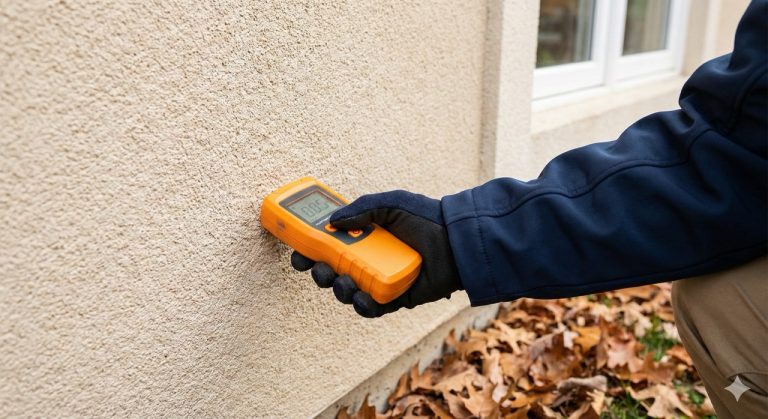
Stucco moisture testing means probe testing — small holes drilled at vulnerable points to take direct moisture readings in the sheathing behind the cladding. The holes are patched afterwards. It is the only way to know what is happening behind the wall.
It is worth ordering when any of these apply:
- The house has EIFS and predates the late 1990s
- Your walk-around turned up two or more of the signs above
- There is any interior evidence — staining on exterior walls, damp smell, warped trim near windows
- The property has had exterior work done and the seller can’t produce documentation of what was replaced or why
- You simply want certainty on a purchase this size
Note that this is a specialist service, separate from both a general home inspection and from what a stucco contractor does. Inspection and remediation are best kept independent — you want the assessment from someone with no interest in the size of the resulting repair. More on what stucco inspections actually cover.
Step Four: What to Do With What You Find
This is where buyers of stucco homes have real leverage, and where most of them under-use it.
A moisture inspection report is documented, third-party evidence of a defect. It is not an opinion, and it is not something a seller can easily dismiss. Once you have it, the realistic options are:
| What the report shows | Reasonable position |
|---|---|
| Clean readings throughout | Proceed with confidence — you now know more than the seller did |
| Isolated elevated readings at one or two openings | Targeted repair, negotiated as a credit or seller-completed before closing |
| Multiple areas elevated, contained damage | Get scoped repair quotes and negotiate against them, not against a guess |
| Widespread saturation or confirmed sheathing rot | Full remediation territory — price it properly or reconsider the purchase |
The distinction that matters in that last row is between repair and remediation. Repair addresses a defined area. Remediation means removing the cladding across affected elevations, replacing damaged sheathing, correcting the flashing and barrier detailing, and rebuilding the wall system. They are different jobs at very different scales, and conflating them is how buyers end up with a number that turns out to be wrong.
If a seller agrees to fix a problem before closing, get specifics in writing: what will be opened, what will be replaced, and who will verify the result. Cosmetic patching over a moisture problem looks like a completed repair and resolves nothing. A re-inspection after the work, at your cost if necessary, is worth having.
Is a Stucco Home Worth Buying?
Yes, frequently. Correctly installed and maintained stucco is rated for decades of service, and mid-century stucco walls across New Jersey are still performing. The material is not the problem.
What makes stucco different from a buyer’s point of view is that its worst failure mode develops out of sight. Vinyl and fiber cement tell you when something is wrong. Stucco often does not until the damage is advanced. That asymmetry is the entire reason for doing this due diligence — not because stucco is bad, but because the usual signals you’d rely on aren’t available.
New Jersey and eastern Pennsylvania add a regional factor: roughly 90 to 110 freeze-thaw cycles a year and over 45 inches of annual precipitation put more stress on flashing and sealant details than a milder climate would. A stucco house here with sound details is fine. One with neglected details deteriorates faster than the same house would elsewhere.
Frequently Asked Questions
Originally from Poland, Kamil spent years mastering stucco and exterior finishing before founding JARART LLC in New Jersey. Over a decade of NJ and PA projects — from Mercer County residences to commercial work for Marriott and Hyatt and the BAPS Swaminarayan Akshardham Temple in Robbinsville, NJ, the largest Hindu temple in the USA. JARART LLC works with Senergy-Sika, Dryvit, Sto, Sherwin-Williams, Behr, Pecora and Benjamin Moore materials.