Stucco Remediation: What It Is, When You Need It, and What to Watch For
Remediation means taking the wall apart and rebuilding it properly. It is the right answer when water has been getting behind stucco for years — and the wrong answer, sold far too often, when the problem is confined to one elevation.
Stucco remediation is the removal of failed cladding down to the substrate, replacement of any water-damaged sheathing and framing, correction of the flashing and weather barrier details that let water in, and reconstruction of the wall. It is not a bigger repair. It is a different job, and it exists because surface repairs cannot fix a wall whose underlying detailing was wrong from the start.
The term is used more here than almost anywhere else in the country, and that is not an accident. Southeastern Pennsylvania and central New Jersey saw widespread stucco and EIFS failures on homes built through the 1990s and 2000s — enough of them, and enough litigation, that “remediation” became a recognised category of work in this region rather than a general word for fixing something.
Remediation vs Repair: The Distinction That Decides Everything
This is the question behind almost every enquiry we get on the subject, and getting the answer right determines whether you spend appropriately or badly.
| Repair | Remediation | |
|---|---|---|
| What gets touched | Defined areas — a crack, a section, a joint | Entire elevations, down to the framing |
| Addresses the cause? | Sometimes — if the cause is local | Yes, by design |
| Windows and doors | Usually stay in place | Often removed and reset with correct flashing |
| Weather barrier | Untouched | Replaced |
| Appropriate when | Damage is contained and the assembly is otherwise sound | Sheathing is damaged, or the detailing itself failed |
The practical test: if the water got in because of one specific, fixable defect, that’s repair. If it got in because the wall was never detailed to keep it out, that’s remediation. A missing kickout flashing at one roof junction is a repair. An entire elevation built with no drainage plane behind the cladding is not something you can patch your way out of.
What Actually Happens During Remediation
The sequence is consistent across any competent remediation job:
- Assessment and moisture mapping. Probe readings across each elevation establish where moisture is present and how far it extends. This defines the scope — and it should be documented before anything is opened, not decided on site with a hammer in hand.
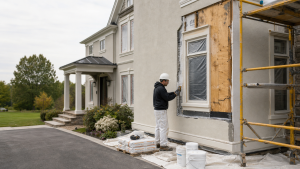
- Removal down to substrate. The cladding comes off the affected elevations. What’s underneath is only fully visible at this point, which is why an honest contractor tells you upfront that scope can expand once the wall is open.
- Structural repair. Water-damaged sheathing is cut out and replaced. Where rot has reached framing, that gets addressed too. This is the part you are actually paying for — everything else is access and finish.
- Correcting the cause. New weather-resistant barrier, properly lapped. Flashing installed where it was missing — kickouts at roof-wall junctions, head flashing over openings. Windows and doors frequently removed and reset so the flashing can be integrated correctly rather than caulked over.
- Rebuilding the wall. New cladding installed over the corrected assembly, with texture and colour matched to whatever remains of the original.
Window head and sill transitions are the most common water entry point on a stucco house. On a genuine remediation, integrating flashing correctly at those openings usually means pulling the window and resetting it. A proposal that strips an elevation to the sheathing but leaves every window in place and relies on new sealant at the perimeter has skipped the part that most often caused the failure. There are situations where that’s defensible — ask the contractor to explain which one applies.
You Probably Don’t Need the Whole House Done
Most articles on this subject describe remediation as an all-or-nothing exercise across every exterior wall. In practice that is frequently over-scoping, and it is the single most expensive assumption a homeowner can accept without questioning.
Stucco failures are usually directional. The weather side of a house — typically south and west in this region — takes the wind-driven rain, and that is where transitions fail first. A north elevation that has never been tested the same way, on a house with the same detailing, may be entirely dry. Moisture mapping tells you which is which.
That said, there is a real argument in the other direction, and it deserves to be stated honestly: if the detailing on the failed elevations was wrong, the same detailing exists everywhere else on the house. Those walls may be dry today because they haven’t been stressed yet. Doing one elevation now and another in four years costs more in total than doing both at once, and mobilising scaffolding twice is genuinely wasteful.
The reasonable position is neither extreme. Scope should follow the moisture data, with an informed conversation about elevations that read dry but share the same defective detailing. What should not happen is a whole-house price quoted before anyone has mapped anything.
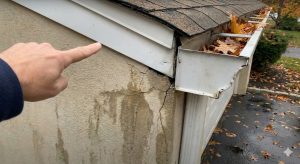
Ask the contractor to tell you, specifically, how the water got in. Not “moisture intrusion” — where, through what detail, and why that detail failed. Someone who has genuinely assessed the house can point at a roof junction or a window head and explain the mechanism. Someone who can’t is quoting a volume of work rather than a solution, and the same failure will happen again in the new wall.
Does Homeowners Insurance Cover Stucco Remediation?
Usually not, and it is worth understanding why before you spend time on a claim.
Standard homeowners policies are built around sudden and accidental loss. A storm tearing cladding off the wall, a tree strike, a burst pipe — those are covered perils. Water that has been seeping past a failed window transition for six years is not sudden, and insurers classify it as gradual damage, a maintenance issue, or faulty workmanship. All three are standard exclusions in almost every policy.
Related exclusions that commonly come up on stucco claims:
- Mould from gradual intrusion — typically excluded outright, or capped at limits far below the cost of the work
- Pre-existing conditions — damage that began before your policy started, which matters if you bought the house with the problem already developing
- Earth movement — cracking from settlement requires separate coverage
- EIFS specifically — some carriers decline to cover homes with it at all, or will only cover drainable systems
Two things that are worth pursuing rather than assuming. First, a denial is not necessarily final — insurers deny stucco claims routinely, and appeals supported by a forensic inspection report do sometimes succeed. Second, insurance is not the only avenue: where failure traces to defective original construction, builder liability or a builder’s warranty may apply, and that is a different conversation entirely.
We are contractors, not insurance advisers, and every policy is different. Read your own policy language on water damage, faulty workmanship and mould before drawing conclusions, and speak to your carrier or a public adjuster about your specific situation. What we can tell you is what we see: most remediation in this region is paid for by the homeowner.
Do You Have to Put Stucco Back?
No. Once the wall is open, the cladding decision is genuinely open too, and this is a good moment to make it deliberately rather than by default.
Putting stucco back makes sense when you want the seamless look, the fire resistance, and the longest service life — and when you now have a wall that has been detailed correctly, which is exactly what remediation delivers. Stucco rebuilt over a sound assembly with proper flashing is a genuinely long-lived exterior.
Switching to fiber cement or another cladding makes sense if the house has structural movement, or if you would simply rather have an exterior whose failures show up on the surface where you can see them. Our comparison of stucco against vinyl, fiber cement and wood covers the trade-offs.
What matters far more than the material is the assembly behind it. A wall with correct flashing and a proper drainage plane performs well in almost any cladding. A wall without them fails in all of them.
Remediation in Bucks County and Mercer County
This region is where the term originated, and the reasons are specific rather than general.
The housing stock is the first factor. Doylestown, Newtown, Yardley, New Hope and Richboro all have significant numbers of homes built during the period when barrier EIFS and poorly detailed stucco were standard practice — systems designed to be watertight at the surface, with no drainage path for water that inevitably got past it. Those installations are now decades old.
The climate is the second. Roughly 90 to 110 freeze-thaw cycles a year and over 45 inches of annual precipitation, much of it wind-driven during nor’easters, test wall transitions harder than a milder climate would. A detailing shortcut that might go unnoticed for decades elsewhere surfaces here much faster.
We work across both counties on this kind of work — see our Doylestown and Newtown service pages, or the full Bucks County and Mercer County overviews.
Frequently Asked Questions
Originally from Poland, Kamil spent years mastering stucco and exterior finishing before founding JARART LLC in New Jersey. Over a decade of NJ and PA projects — from Mercer County residences to commercial work for Marriott and Hyatt and the BAPS Swaminarayan Akshardham Temple in Robbinsville, NJ, the largest Hindu temple in the USA. JARART LLC works with Senergy-Sika, Dryvit, Sto, Sherwin-Williams, Behr, Pecora and Benjamin Moore materials.