Stucco vs Plaster: The Difference Isn’t What Most Sources Say
Stucco is plaster. Specifically it’s exterior plaster, and the technical name for it is Portland cement plaster. What separates it from the plaster on your interior walls is the binder — and the popular explanation of that binder is out of date by about a century.
Stucco and plaster are the same family of material: a binder, an aggregate and water, applied wet and cured hard. The difference is which binder, and that determines where each one can survive. Portland cement for exteriors, lime for either, gypsum for interiors only.
The Part Most Explanations Get Wrong
Search for the difference between plaster and stucco — or plaster vs stucco, the same question either way round — and you will repeatedly find this: stucco is lime-based, plaster is gypsum-based.
That was true in 1890. It is not an accurate description of what goes on buildings now. Modern exterior stucco is bound with Portland cement — lime is present, but as an additive that improves workability and adds a little flexibility, not as the primary binder. This is why the technical term in the trade and in standards is Portland cement plaster, and why the material is covered by ASTM C926 rather than by any lime-plaster standard.
The accurate three-way split looks like this:
| Binder | Common name | Where it works | Why |
|---|---|---|---|
| Portland cement | Stucco, exterior plaster | Exterior | Hard, weather-tolerant, unaffected by repeated wetting |
| Lime | Lime plaster, historic stucco | Both | Breathable and self-healing on fine cracks; softer than cement |
| Gypsum | Plaster, plaster of Paris | Interior only | Degrades on repeated exposure to water |
So the honest short answer to “what is the difference between stucco and plaster” is that stucco is one kind of plaster — the kind formulated to survive outside. Everything else people cite as the difference, including texture and hardness, follows from that.
This isn’t pedantry. If someone tells you your exterior wall is “plaster,” you don’t yet know whether they mean modern cement stucco or historic lime plaster, and those need completely different repair materials. Getting that wrong on an old house does real damage. When I look at a wall on a nineteenth-century building, establishing which one I’m dealing with is the first thing I do, before anything else.
Exterior Plaster on Older Homes: The Repair Mistake
This matters in Bucks and Mercer County more than in most places, because the housing stock includes a lot of genuinely old buildings — Doylestown, New Hope and Newtown all have significant nineteenth-century and earlier fabric, much of it originally finished in exterior lime plaster.
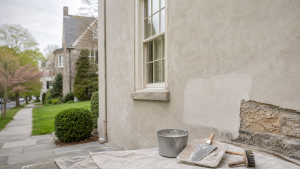
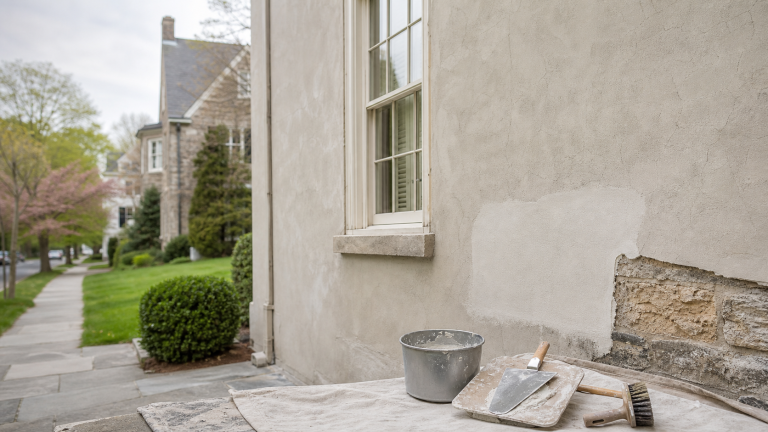
Repairing historic lime plaster with modern cement stucco is a well-recognised way to damage an old building. The reason is that the two materials have different properties in two respects that both matter:
- Hardness. Cement is considerably harder than lime. In a wall that moves seasonally, a rigid cement patch in a softer lime field doesn’t flex with it — so the stress goes into the original material around the patch, and the old work fails at the edges of the new.
- Breathability. Lime plaster is highly vapour-permeable, and old masonry walls generally depend on being able to dry through their finish. A cement patch is far less permeable, so moisture that used to evaporate through the wall face is now redirected — usually into whatever is adjacent, including the original lime and the masonry behind it.
The principle for lime plaster exterior work is straightforward: repair material should be no harder and no less permeable than what it’s going into. On a lime-plastered historic wall, that means lime-based repair, not cement.
Doylestown and New Hope both operate architectural review for exterior work within their designated districts, and Hopewell Township’s preservation commission reviews for historic compatibility in some cases even outside formal districts. Material choice on a historic exterior can be part of what gets reviewed — worth establishing before work is specified rather than after.
Exterior Venetian Plaster: How It Differs From Stucco
Venetian plaster is a distinct thing again: a lime-based finish applied in thin layers and burnished to a polished, marble-like surface. It is not a structural or protective coating in the way stucco is — it is decorative, and its appeal is depth and sheen rather than weather resistance.
Venetian plaster vs stucco comes down to purpose: one decorates, the other protects. Can it go outside? Yes, with the right formulation and detailing. Venetian plaster exterior grades exist and perform, but it demands more than an interior application does: the substrate has to be right, the wall needs protection from standing water and driving rain at the top, and the finish needs appropriate sealing for external exposure. It is skilled application work, not a product decision.
Our own experience with it is on the BAPS Swaminarayan Akshardham Temple in Robbinsville — acrylic and Venetian stucco alongside waterproofing and colour matching on one of the largest projects of its kind in the country. That work is why we treat exterior Venetian as its own discipline rather than as a finish option on a normal stucco job.
Which Do You Have, and What Does It Need?
Practical identification, in the order worth checking:
- Is it interior or exterior? Exterior in this climate is cement stucco or historic lime. Gypsum plaster does not survive outdoors and if you find it on an exterior wall, something has gone wrong.
- How old is the building? Pre-1900 exterior work in this region is likely lime. Twentieth century onward is likely Portland cement. This narrows the odds without settling it.
- How does it behave? Lime is softer — it can often be scratched with a key where cement stucco cannot. Lime also tends to have a slightly softer, chalkier surface character.
- What has been done to it since? Many historic lime walls have already been patched or overcoated with cement at some point. Finding that is useful, because it often explains the cracking pattern you’re looking at.
Exterior plaster repair follows from that identification. Cement stucco repairs with cement-based material; historic lime repairs with lime. Applying the second rule to the first wall is merely suboptimal. Applying the first rule to the second wall causes damage.
Frequently Asked Questions
Originally from Poland, Kamil spent years mastering stucco and exterior finishing before founding JARART LLC in New Jersey. Over a decade of NJ and PA projects — from Mercer County residences to commercial work for Marriott and Hyatt and the BAPS Swaminarayan Akshardham Temple in Robbinsville, NJ, the largest Hindu temple in the USA. JARART LLC works with Senergy-Sika, Dryvit, Sto, Sherwin-Williams, Behr, Pecora and Benjamin Moore materials.