
Stucco Maintenance: What Actually Matters, Season by Season
Most stucco maintenance advice tells you to seal the surface. On a Mid-Atlantic home that advice is frequently wrong — and the things that genuinely extend a stucco wall’s life get almost no attention by comparison.
Stucco maintenance comes down to three things: keeping sealant intact at every opening, keeping flashing sound, and keeping water moving away from the base of the wall. Everything else — washing, sealing, repainting — is secondary, and in one case can actively cause harm.
That ordering matters, because it is close to the opposite of how stucco upkeep is usually presented. Search for how to maintain stucco and you’ll mostly find advice about cleaning and sealing the surface. Both are real tasks. Neither is what decides whether your wall is sound in twenty years.
Should You Seal Stucco? The Honest Answer
This is the most common question we get about stucco care, and the most common place homeowners are given bad advice. A stucco sealer is not automatically a good idea, and on some walls it makes the underlying problem worse.
The reason goes back to how a stucco wall works. Traditional cement stucco is a reservoir cladding — it absorbs water during rain, holds it, and releases it as the wall dries outward. It was never meant to be a waterproof membrane. The actual waterproofing is the barrier and flashing behind it.
Apply a low-permeability sealer or waterproofing coating to that wall and you restrict its ability to dry outward. If the wall is genuinely dry to begin with, that is often harmless. If moisture is already getting in behind the stucco — through a failed window transition, say — you have just removed one of the two directions it could escape. The water does not stop arriving. It stops leaving.
A homeowner notices staining or damp patches, is told the stucco is “porous and needs sealing,” and has a waterproofing product applied. The visible symptom improves for a season or two. Meanwhile the actual entry point is untouched and the sheathing behind the wall is now drying more slowly than before. Sealing is not a substitute for finding where water is getting in.
When sealing does make sense: on sound, dry walls, using a breathable (vapour-permeable) product, as protection against surface absorption rather than as a fix for anything. If someone proposes a sealer or waterproofing treatment in response to a stain, a leak or a damp interior wall, ask them where they’ve established the water is entering. If there’s no specific answer, the treatment is cosmetic.
What Actually Determines How Long Stucco Lasts
Correctly installed hard-coat stucco is rated for 50 to 80 years, and mid-century stucco walls across New Jersey are still performing. Almost none of them fail because the stucco wore out. They fail because water reached the sheathing and nobody knew.
Three maintenance items carry nearly all the weight:
- Perimeter sealant. Every window, door, vent, light fixture, hose bib and electrical penetration is a hole in an otherwise continuous surface. The sealant at those joints is the only thing keeping water out of them, and sealant is a consumable — it hardens, shrinks and pulls away from one side of the joint. This is the highest-return maintenance task on a stucco house and the most commonly neglected.
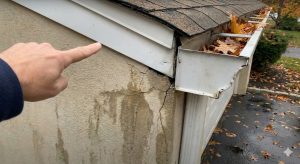
- Flashing. Kickout flashing at roof-to-wall junctions, head flashing above windows, and step flashing along rooflines direct water back out of the assembly. When flashing is missing, damaged or was never installed correctly, water enters the wall at a concentrated point and keeps entering every time it rains. Flashing problems are the single most common cause of serious stucco damage we’re called to.
- Drainage and grade. Water needs to move away from the base of the wall. Blocked gutters, downspouts discharging next to the foundation, soil built up against the stucco, or mulch piled over the base of the wall all put standing moisture where the assembly can’t shed it.
Before I look at a single crack, I walk the perimeter and look up at the roofline. Where a roof edge meets a wall that continues past it — that’s where kickout flashing belongs, and it’s missing more often than people would believe. Then I check the sealant at the window heads on the weather side of the house, usually south and west. If those two things are right, the wall is usually fine. If either is wrong, I know roughly what I’m going to find when we open it.
The Seasonal Calendar for NJ and PA
Stucco maintenance is seasonal here for a specific reason. New Jersey and eastern Pennsylvania go through roughly 90 to 110 freeze-thaw cycles a year, and get over 45 inches of precipitation. Water sitting in a hairline crack in November is a wider crack in March. Timing your maintenance around that cycle is most of the benefit.
| Season | Priority | Why now |
|---|---|---|
| Spring | Inspection & crack assessment | Freeze-thaw damage from the winter is now visible at its worst |
| Summer | Cleaning, landscaping, irrigation | Dry weather; the season when sprinklers and vegetation cause damage |
| Fall | Sealant, flashing, drainage | The critical window — last chance before freezing |
| Winter | Monitoring only | Most repair work can’t cure properly below freezing |
Spring — find out what winter did
Walk the perimeter on a dry day and look at the wall from a few feet back, then close up. You’re looking for cracks that weren’t there in autumn, cracks that have widened, staining below window corners, and any area that looks darker than the surrounding wall after rain has dried elsewhere.
Pay attention to crack width and direction, not just presence. Fine surface crazing is normal ageing. Diagonal cracks radiating from window and door corners suggest structural movement. A crack you can fit a fingernail into is past the point of surface treatment. Our crack repair guide covers how to read them.
Spring is also when road salt residue near driveways and walkways should come off the lower wall, before it sits through another season.
Summer — the season of self-inflicted damage
Most summer stucco problems are avoidable and come from things that have nothing to do with the stucco itself:
- Irrigation hitting the wall. A sprinkler head that sprays the base of the stucco every morning keeps that section permanently damp and produces staining, efflorescence and eventually deterioration. Adjust the heads.
- Vegetation against the wall. Shrubs and climbing plants trap moisture against the surface and prevent it drying. Keep planting back from the wall.
- Mulch and soil piled against the base. Stucco needs clearance above grade. Burying the base of the wall puts it in permanent contact with wet soil.
Summer is also the practical time for washing, if the wall needs it — see our guide to cleaning stucco safely, particularly the section on why pressure washing damages stucco.
Fall — the one that actually matters
If you only do maintenance once a year, do it in autumn. Everything you fix now is something water cannot exploit over the winter, and everything you leave is something the freeze-thaw cycle will work on for four months.
- Inspect and replace failed sealant at every window, door and penetration. Sealant that has hardened, cracked or separated from one side of the joint is no longer doing anything.
- Repair open cracks before they can hold water through a freeze. Temperatures need to be reliably above freezing for repair material to cure, which is what makes early-to-mid autumn the window.
- Clear gutters completely and confirm downspouts discharge well away from the wall base.
- Check that soil and mulch haven’t built up against the stucco over the growing season.
Winter — watch, don’t work
Cement-based repair materials need temperatures above freezing to cure properly, and sealant applied to a cold or damp surface won’t bond. Winter is for monitoring, not repair.
What to watch for: interior staining on exterior walls or ceilings, damp patches that appear after a thaw, and icicles forming at a specific point on the wall rather than along the gutter line — that last one often indicates water getting somewhere it shouldn’t. If you see any of these, note the location. It’s diagnostic information for spring.
If something genuinely urgent happens mid-winter — a large impact hole, storm damage — temporary protection is the right response. Permanent repair waits for weather that lets it cure.
What You Can Handle and What Needs a Contractor
Some of this is straightforwardly a homeowner job. Some of it isn’t, and the distinction is worth being honest about.
| Task | Realistic for a homeowner? |
|---|---|
| Visual inspection, noting changes year to year | Yes — and genuinely valuable |
| Clearing gutters, adjusting sprinklers, cutting back planting | Yes |
| Gentle washing of accessible wall areas | Yes, with care |
| Re-caulking a ground-floor window joint | Yes, if you’re comfortable with the prep |
| Anything requiring a ladder at height | No — access is the real risk |
| Repairing cracks wider than a hairline | No — needs diagnosis of the cause first |
| Flashing inspection or repair | No — usually means opening part of the wall |
| Anything after you’ve seen interior water staining | No — that’s a diagnostic job, not maintenance |
The honest line is this: inspection and prevention are yours, and doing them well is worth more than most people expect. Diagnosis and anything involving the concealed part of the assembly isn’t, because getting it wrong means the wall keeps deteriorating while looking fixed.
Frequently Asked Questions
Originally from Poland, Kamil spent years mastering stucco and exterior finishing before founding JARART LLC in New Jersey. Over a decade of NJ and PA projects — from Mercer County residences to commercial work for Marriott and Hyatt and the BAPS Swaminarayan Akshardham Temple in Robbinsville, NJ, the largest Hindu temple in the USA. JARART LLC works with Senergy-Sika, Dryvit, Sto, Sherwin-Williams, Behr, Pecora and Benjamin Moore materials.