How to Choose a Stucco Contractor in NJ and PA
New Jersey does not license stucco contractors. It registers them — a weaker thing than most homeowners assume. Knowing what that registration does and doesn’t prove is the difference between a real check and a reassuring one.
Start with three verifiable things: that the contractor is registered with the state, that their registration number appears on the written estimate, and that they can tell you specifically what caused the problem you called about. The first two take minutes to check. The third separates most good contractors from most bad ones.
What New Jersey and Pennsylvania Actually Require
This is worth being precise about, because the language people use — “licensed and insured” — obscures what is actually being claimed.
There is no stucco contractor New Jersey licence to hold. An NJ stucco contractor is not licensed by the state in the way an electrician or plumber is. It operates a registration system: the Home Improvement Contractor (HIC) programme, administered by the Division of Consumer Affairs under the Contractors’ Registration Act. Any contractor doing residential home improvement work of $500 or more must be registered. Registration is not exam-based — it does not test competence. What it does require is proof of commercial general liability insurance with a minimum of $500,000 per occurrence.
The detail most useful to you as a homeowner: the HIC registration number must appear on all contracts, advertisements and written estimates. If you have an estimate in hand with no registration number on it, that is not a paperwork oversight — it is a compliance failure, and it tells you something before you have checked anything else.
New Jersey has also tightened the requirements in recent years, adding workers’ compensation insurance and additional security to the registration conditions, and the state has been moving toward individual licensing on top of business registration. Because this framework is actively changing, the Division of Consumer Affairs is the authority on what applies right now — their contractor registration database is public and searchable.
Pennsylvania runs a comparable system through the Office of the Attorney General, and it is separate. Registration in one state does not carry to the other. A contractor working across the Delaware — as many in this region do — needs to be registered in both.
Registration confirms that a stucco company exists as a business, carries the required insurance, and has paid a fee. It does not test skill, does not verify experience with your specific system, and does not indicate quality of work. Treat it as a floor rather than a recommendation — an unregistered contractor is disqualified, but a registered one has only cleared the minimum.
The Questions That Actually Sort Contractors
Most advice on hiring a stucco repair contractor suggests asking about experience and references. Useful, but easy to answer well without meaning much. These are more diagnostic:
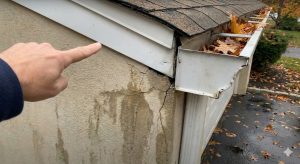
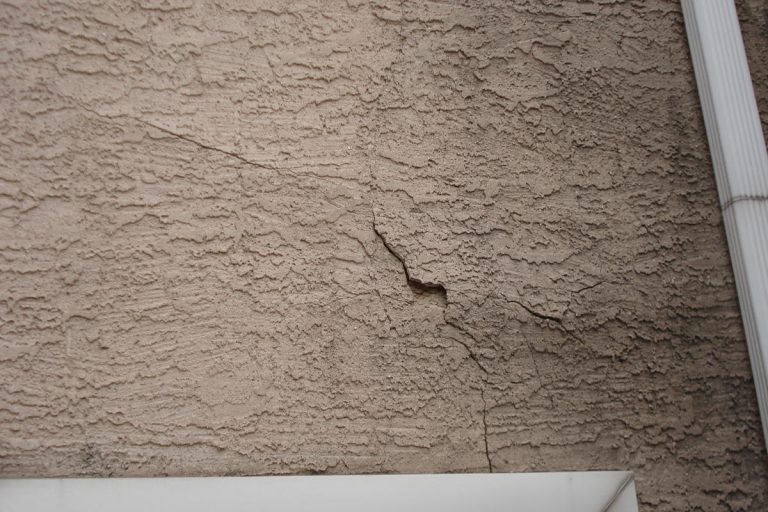
- “What caused this?” The single most revealing question. Someone who has assessed the wall can name a mechanism — a missing kickout at a specific roof junction, a window head detail, movement at an opening. Someone who describes the work without describing the cause is quoting a volume of material. The same failure returns in the new wall.
- “Which system is on my house?” Hard coat, EIFS or cement board. If the answer is vague, or the terms get used interchangeably, they have not looked properly — and the repair method differs for each.
- “How do you know the sheathing behind it is sound?” On a concealed system this is the question that matters. Acceptable answers involve moisture readings or opening a section. “It looks fine from here” is not one.
- “What happens if you find more damage once it’s open?” An honest contractor tells you upfront that scope can expand on a concealed system, and explains how that will be handled and priced. One who promises certainty before the wall is open is either inexperienced or managing you.
- “Are you doing the work, or subcontracting it?” Neither answer is wrong. But you should know who will actually be on the scaffolding, and who carries the warranty.
Don’t line them up by price first. Line them up by diagnosis. If two contractors describe the same cause and one describes something different — or nothing at all — that’s the useful signal, and it’s usually clearer than any number. Two quotes for genuinely different scopes of work aren’t comparable anyway, and comparing them as if they were is how people end up choosing the one that skipped the important part.
Red Flags Worth Taking Seriously
- No registration number on the estimate. Required by law in NJ. Its absence is a direct signal.
- A fix proposed without a cause identified. Particularly coating or re-caulking offered in response to a leak. Surface treatment does not stop water entering at a transition.
- Pressure to decide immediately, or a discount that expires. Legitimate work does not require urgency to close.
- Large payment up front. A reasonable deposit is normal; being asked to fund most of the job before it starts is not.
- Whole-house scope quoted before anything has been assessed. Stucco failures are usually directional. A price for every elevation, offered before moisture mapping, is a volume quote. More on scoping remediation properly.
- Reluctance to put the scope in writing. In New Jersey this is not just a preference — written contracts are required above $500.
What the Written Contract Must Contain
New Jersey regulation sets out what a home improvement contract has to include, and these requirements exist because this trade generated enough complaints to warrant them. On any residential job over $500 you should expect:
- The work in writing, with the total price stated
- Start and completion dates
- The contractor’s HIC registration number
- A three-day right of rescission — you can cancel within three business days of signing
Beyond the legal minimum, worth insisting on for stucco work specifically: which elevations are in scope, what happens if additional damage is found once the wall is open, whether windows will be removed and reset, what the warranty covers and for how long, and who is responsible for making good the landscaping and site afterwards.
Frequently Asked Questions
Originally from Poland, Kamil spent years mastering stucco and exterior finishing before founding JARART LLC in New Jersey. Over a decade of NJ and PA projects — from Mercer County residences to commercial work for Marriott and Hyatt and the BAPS Swaminarayan Akshardham Temple in Robbinsville, NJ, the largest Hindu temple in the USA. JARART LLC works with Senergy-Sika, Dryvit, Sto, Sherwin-Williams, Behr, Pecora and Benjamin Moore materials.