Outdoor Stucco: Kitchens, Fireplaces and Patio Walls That Actually Last
Stucco on a freestanding outdoor structure is a harder job than stucco on a house, and for a specific reason: a house wall dries inward when it has to. A garden wall, an outdoor kitchen or a chimney has no inside to dry into.
Outdoor stucco works well on kitchens, fireplaces, patio walls and columns — but only where the structure is detailed for water from every direction, capped properly at the top, and kept clear of the ground. Most outdoor stucco failures trace to one of those three things rather than to the stucco itself.
Why Freestanding Structures Fail Differently
A stucco house wall is one side of an assembly. Water that gets past the surface meets a weather barrier, and the wall can dry outward, or inward into conditioned space, or both. There is somewhere for moisture to go.
A freestanding outdoor structure has none of that. Consider what an outdoor kitchen island or a garden wall is actually exposed to:
- Weather on both faces. Rain hits front and back. There is no protected side.
- An exposed top. On a house, the roof handles this. On a freestanding wall, the top is a horizontal surface pointed straight at the sky — and horizontal surfaces are where water sits rather than runs.
- Direct contact with the ground. Garden structures usually start at grade, which means wicking moisture up from soil continuously.
- Nowhere to dry. No conditioned interior, no ventilated cavity. Whatever gets in leaves the way it came or not at all.
- Full temperature swing. Both faces cycle with the air. In this region that means roughly 90 to 110 freeze-thaw cycles a year working on saturated material from both sides.
That combination is why outdoor stucco fails faster than house stucco when it is detailed casually — and why it lasts perfectly well when it isn’t.
If I could only fix one thing on an outdoor stucco structure, it would be the cap. A wall that sheds water off the top properly — with an overhang and a drip edge so water leaves the structure instead of running back down the face — survives almost anything. A wall with a flat stuccoed top is absorbing water into the core every time it rains, and no amount of quality in the finish coat compensates for that.
Stucco Outdoor Kitchens
Stucco is a natural finish for an outdoor kitchen: seamless, available in any colour, and it lets a structure match the house rather than looking like a separate build. It is also low-maintenance in a place where wood would not be.
Choosing stucco for outdoor kitchen work is straightforward aesthetically. What matters technically, and what determines how outdoor kitchen stucco holds up, is this — the practical answer to how to stucco outdoor kitchen structures properly:
- The substrate has to suit it. Block or a proper framed-and-sheathed structure with cement board — not bare metal framing with the finish applied straight over. Prefabricated kitchen frames vary enormously in what they’re built to receive.
- Countertop overhang and flashing. Where the counter meets the stucco is a horizontal-to-vertical transition, and it needs to shed water outward rather than into the joint. This is the most common leak point on an outdoor kitchen.
- Heat clearance at appliances. Grills and burners need specified clearances from combustible material and from finish surfaces. Follow the appliance manufacturer’s figures rather than a general rule.
- Access panels. Plumbing and gas need to remain reachable. Stuccoing over a shutoff valve creates a problem for whoever deals with it later.
- Base clearance. The stucco should not run into the patio surface. Where it does, it wicks.
Stucco Outdoor Fireplaces
An outdoor stucco fireplace adds a factor nothing else on this list has: sustained heat, cycling against material that also freezes in winter. Building a stucco fireplace outdoor rather than indoors means the structure takes both extremes.
The critical distinction is between the firebox and the surround. The firebox itself is masonry work — firebrick and refractory mortar, rated for direct flame contact. Stucco is a finish for the exterior of the surround, at a distance from the fire, and it is not a fireproof material in that sense. Any design that puts a stucco finish where it takes direct heat is wrong regardless of how well it is applied.
Beyond that, the same principles as any outdoor structure apply, with two additions. The chimney or flue termination needs a proper cap and flashing — chimneys are the most weather-exposed element of any structure and outdoor ones are no different. And expansion from heat cycling makes control joints and a flexible finish more valuable here than elsewhere; an acrylic finish tolerates that movement better than a rigid cementitious one.
Outdoor fireplaces and kitchens frequently involve permits, setback requirements from property lines and structures, and in the case of gas appliances, inspection. Requirements vary between municipalities in Mercer and Bucks County. This is worth establishing before design rather than after — it can affect placement, height and clearances.
Patio Walls, Columns and Screens
The simplest outdoor applications, and the ones where detailing shortcuts show up fastest.
A stucco patio wall, screen or column needs three things: a cap that overhangs and drips clear, a base that starts above grade rather than in it, and a substrate that suits stucco — block or properly prepared masonry. A stucco finish over a structure that moves seasonally will crack, and freestanding garden structures on shallow footings move more than a house does.
On a patio cover with stucco columns, the connection between column and the structure above matters. Water running down the underside of a beam and onto a column top finds any gap in the finish there.
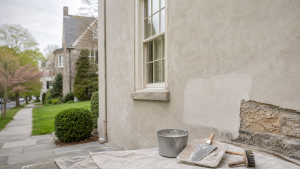
Applying Stucco Over an Existing Outdoor Surface
A common project: an existing block wall, or a tired outdoor structure someone wants to refresh with stucco.
It can work well. The constraint is bonding. Stucco keys mechanically into an absorptive surface, which means:
- Painted or sealed surfaces must be stripped to bare substrate. Stucco applied over paint delaminates — reliably, usually within a season or two outdoors where the freeze-thaw exposure is harshest.
- Bare block, brick and masonry take stucco well with proper preparation and dampening.
- Smooth or dense surfaces may need a bonding agent or a mechanical key rather than direct application.
- Fix the drainage first. Applying new stucco over a structure that already wicks from the base just puts a fresh finish on the same problem.
What Makes Outdoor Stucco Last
Summarised, because it is a short list and it is the same list every time:
- A cap with an overhang and a drip edge. Nothing else on this list matters as much.
- Clearance above grade so the base is not sitting in soil or against a patio surface.
- Drainage away from the structure, so the ground around it isn’t holding water against the base.
- A flexible finish and control joints where movement or heat cycling is expected.
- Annual sealant checks at penetrations. UV and temperature cycling degrade sealant faster on an exposed outdoor structure than on a shaded house wall, so it needs replacing more often than you’d expect.
Frequently Asked Questions
Originally from Poland, Kamil spent years mastering stucco and exterior finishing before founding JARART LLC in New Jersey. Over a decade of NJ and PA projects — from Mercer County residences to commercial work for Marriott and Hyatt and the BAPS Swaminarayan Akshardham Temple in Robbinsville, NJ, the largest Hindu temple in the USA. JARART LLC works with Senergy-Sika, Dryvit, Sto, Sherwin-Williams, Behr, Pecora and Benjamin Moore materials.