How to Paint Stucco: A Contractor’s Step-by-Step Guide
Painting stucco is one of the more forgiving DIY exterior projects — when the prep is done correctly. Skip the prep and you’ll be repainting in three years. This guide covers what actually matters, in the right order.
Painting stucco extends its lifespan, refreshes faded color, and can bridge minor surface cracking — but only when the wall beneath is in the right condition to receive it. The paint itself is straightforward. The decisions that determine whether it lasts 3 years or 15 happen before the roller touches the wall.
JARART LLC paints stucco exteriors across New Jersey and Pennsylvania as part of both standalone painting projects and post-repair restoration work. This guide covers the process as we actually execute it — including the substrate checks most guides skip. For the full scope of what professional stucco painting involves, see our stucco painting services page.
Before You Paint: What Needs to Happen First
Two conditions disqualify a stucco wall from painting regardless of how well the paint is applied. Both are invisible once the coating goes on — which is why they matter so much to confirm beforehand.
Active moisture intrusion
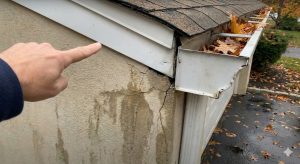
Traditional hard-coat stucco is a breathable system — moisture that enters the wall from behind can exit through the stucco surface as vapor. Elastomeric and acrylic coatings significantly reduce that vapor permeability. Applying them over a wall with active moisture intrusion or elevated substrate moisture content traps that moisture inside, accelerating wood rot and eventually causing the coating to blister and delaminate from behind.
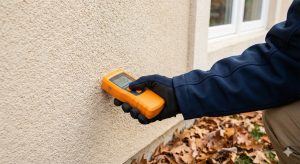
Before painting, confirm: no active water entry at windows, doors, or roof-to-wall junctions. Any caulk failures or flashing issues must be repaired first. If the wall has a history of staining or moisture problems, substrate moisture should be below 12% before coating. See our guide on extending stucco lifespan for the substrate moisture rule in full context.
Structural cracks and surface damage
Elastomeric paints bridge hairline cracks — that’s one of their genuine advantages. They do not bridge cracks wider than approximately 1/32″ reliably over multiple freeze-thaw cycles, and they cannot substitute for actual crack repair on damaged sections. Cracks wider than 1/16″, any delaminated sections, and any areas with spalling or loose material must be repaired before painting. Painting over unrepaired damage doesn’t hide it — it telegraphs it, often more visibly than the original crack. Our stucco repair page covers what pre-paint repair typically involves.
Fresh stucco — whether new installation or a repair patch — must fully cure before any coating is applied. Portland cement-based stucco requires a minimum 28-day cure, and should be moisture-tested before coating. Acrylic finish coats on EIFS cure faster but still need manufacturer-specified dwell time before overcoating. Painting too soon causes adhesion failure and premature peeling regardless of paint quality.
Which Paint to Use on Stucco
Three paint categories are appropriate for exterior stucco. The right choice depends on whether your wall is traditional hard-coat or EIFS, and what performance you’re prioritizing.
Elastomeric paint — the standard choice for hard-coat stucco
Elastomeric coatings are high-build acrylic formulations with a rubber-like flexibility that allows them to expand and contract with the stucco surface through temperature cycling. Key advantages for NJ and PA homeowners: they bridge hairline cracks that would otherwise admit water, provide excellent UV protection, and significantly outperform standard exterior paints on the longevity dimension — 10–15 years when correctly applied over a prepared surface vs. 5–7 for standard latex.
They apply at higher film build (typically 10–12 mils wet) than standard exterior paint, which requires the appropriate roller nap and application technique described below. Sherwin-Williams Loxon, Behr Premium Masonry, and Benjamin Moore Ultra Spec Masonry are all appropriate product families. JARART LLC uses Sherwin-Williams products on most painting projects.
Acrylic masonry paint — good for EIFS and smooth finishes
Standard 100% acrylic exterior masonry paints provide good adhesion to stucco surfaces, UV resistance, and breathability, at a lower film build than elastomeric formulations. Appropriate for EIFS surfaces where the existing acrylic finish coat doesn’t require the high-build crack-bridging properties of elastomeric — and for traditional stucco in good condition where color refresh is the primary goal rather than crack bridging.
Penetrating silane/siloxane sealer — when paint isn’t the goal
If the stucco surface is in good cosmetic condition but water repellency has declined with age, a penetrating silane or siloxane sealer provides water repellency enhancement without changing the surface appearance. It penetrates rather than coating, preserving breathability better than any film-forming product. Not a substitute for paint when color refresh or crack bridging is needed — a complementary product for maintenance-focused applications.
| Product type | Best for | Crack bridging | Lifespan |
|---|---|---|---|
| Elastomeric paint | Traditional hard-coat stucco, aging surfaces | Yes — hairline cracks | 10–15 years |
| Acrylic masonry paint | EIFS, sound surfaces, color refresh | Minimal | 7–10 years |
| Silane/siloxane sealer | Water repellency, maintenance | No | 5–8 years |
A common concern with elastomeric paint is that it “seals” the stucco and prevents breathing. Modern elastomeric formulations are vapor-permeable — they restrict liquid water entry from outside while allowing water vapor to pass outward from inside the wall. This is the same principle as a waterproof breathable fabric. The key condition is that it’s applied over dry substrate: vapor trying to escape a wet wall can be enough to cause blistering even through a “breathable” coating. Dry wall in, breathable coating on — the system works correctly.
Surface Preparation Step by Step
Preparation accounts for the majority of stucco paint job longevity. A mediocre paint well-applied over a properly prepared surface will outlast a premium paint applied over inadequate prep.
Step 1 — Repair any cracks and damage
Address all cracks wider than 1/16″, spalling sections, delaminated areas, and failed caulk at windows and doors before any cleaning or priming. New repair materials need to cure fully (28 days for cement-based patches) before painting over them.
Step 2 — Clean the surface
Stucco’s porous texture traps dirt, dust, biological growth (algae, mildew, moss), and efflorescence (white mineral deposits). Any of these contaminants under the paint will interfere with adhesion and cause premature failure.
- Pressure washing: 1,000–1,200 PSI maximum, 40-degree wide-angle tip, spray downward only — never upward into window perimeters or joints. This removes dirt and loose surface material.
- Biological growth (algae/mildew): treat with a diluted bleach solution (1 part bleach : 3 parts water) or a commercial mildewcide before pressure washing. Allow dwell time per product instructions, then rinse thoroughly. Painting over active biological growth guarantees recurrence under the coating.
- Efflorescence: white powdery mineral deposits require a masonry efflorescence cleaner (diluted muriatic acid or commercial alternatives). Rinse thoroughly after treatment. Do not paint over active efflorescence — it indicates ongoing moisture movement through the wall that will push future deposits up through the coating.
- Drying time: allow minimum 48–72 hours after washing before priming in typical NJ/PA summer conditions. In cooler or humid conditions, allow longer. The wall must be thoroughly dry — not surface-dry — before primer is applied.
Step 3 — Prime
Primer is not optional on stucco. It serves three functions: sealing the porous surface to prevent the topcoat from soaking unevenly into the substrate (which causes lap marks and poor coverage), improving topcoat adhesion, and providing a uniform base for color development. Use a masonry primer specifically compatible with your chosen topcoat — check the paint manufacturer’s recommendation. Loxon Conditioner from Sherwin-Williams and similar alkali-resistant masonry primers are appropriate for most applications.
Apply primer to a clean, dry surface and allow to cure per manufacturer specification before topcoat. In NJ/PA conditions, minimum 4 hours in warm, dry weather — longer in humidity or cool temperatures.
Application Technique
Tools
- Roller: 3/4″ to 1-1/4″ nap depending on stucco texture — heavier texture requires longer nap to work paint into the surface profile. A roller that’s too short leaves the textured surface partially unpainted and produces a mottled appearance.
- Brush: 4″ synthetic bristle brush for cutting in at edges, around windows and doors, and along grade line. Stucco’s texture makes brush application laborious for large areas but necessary at transitions where a roller can’t reach.
- Spray (professional option): airless sprayer provides the most uniform coverage on heavily textured stucco and is significantly faster on large facade areas. Requires back-rolling immediately after spray application to work paint into the surface texture and achieve correct film build. Not recommended for DIY without experience — overspray control on NJ residential properties is demanding.
Application sequence
- Work in manageable sections — a wall face rather than the entire house at once
- Cut in edges and around windows/doors with brush first
- Roll the field immediately after cutting in the section — don’t let cut-in dry before rolling adjacent areas
- Work top to bottom to catch any drips with the roller pass below
- Apply two full coats — stucco’s porosity and texture mean a single coat rarely achieves sufficient film build for full coverage and protection
- Allow first coat to dry thoroughly before second — minimum 4 hours in warm conditions; overnight in cool or humid weather
Temperature and weather constraints
- Air and surface temperature: 50°F minimum, 90°F maximum during application and drying
- Do not apply in direct midday sun on south or west walls — surface temperature can exceed air temperature significantly, causing the paint to dry too fast and reducing adhesion
- Do not apply if rain is forecast within 24 hours of application
- Morning application on east and north faces, afternoon on west faces where possible — painting into direct sun is the most common cause of lap marks on stucco
Painting EIFS — Different Rules Apply
EIFS (synthetic stucco) can be painted, but with important differences from hard-coat stucco. The acrylic finish coat on EIFS has a specific chemistry — not all masonry paints are compatible with it, and applying an incompatible product can interfere with the finish coat’s performance or void any remaining manufacturer warranty. See our comparison of EIFS vs traditional stucco for context on how these systems differ.
- Use only 100% acrylic paints specifically compatible with EIFS — not solvent-based products, not elastomeric formulations with high film build that restrict vapor transmission
- Do not apply high-build elastomeric coatings over EIFS — the increased film build reduces vapor permeability more than the system is designed to accommodate
- Confirm the existing EIFS finish is sound and well-adhered before painting — delaminated areas require system-specific repair before any topcoat is applied
- Check manufacturer guidance for your specific EIFS product (Dryvit, Senergy-Sika, Sto) — each has specific approved coating recommendations
Common Mistakes That Cause Early Failure
- Painting over wet substrate — the most consequential mistake. Moisture vapor trapped under a low-permeability coating causes blistering and peeling within one season. Confirm substrate moisture below 12% before coating.
- Skipping primer on bare or repaired stucco — unprimed stucco absorbs topcoat unevenly, produces poor coverage, and reduces adhesion. Always prime fresh repairs and bare sections.
- Painting in direct sun on hot surfaces — causes the coating to skin over before it can wet out the substrate surface properly, producing poor adhesion and visible lap marks. Paint cool surfaces in shade or indirect light.
- One thick coat instead of two thin coats — a single heavy coat sags on vertical surfaces, dries unevenly, and provides inconsistent film build. Two thinner coats produce a more uniform, better-adhered result.
- Painting over active biological growth without treatment — mildew and algae under paint continue growing and eventually push through the coating. Treat, rinse, and confirm elimination before applying any product.
- Using interior paint or non-masonry exterior paint — these products lack the alkaline resistance required for stucco, which has a high pH surface chemistry. They chalk, chalk and peel prematurely.
For keeping the painted surface performing well over time, our seasonal maintenance guide covers inspection schedule and what to watch for as the coating ages.
Substrate prep, primer, elastomeric coatings — NJ & PA · Free written estimate
Crack repair, caulk replacement, and surface prep before any coating project · NJ & PA
Frequently Asked Questions
Kamil and the JARART LLC team paint stucco exteriors across New Jersey and Pennsylvania using Sherwin-Williams, Benjamin Moore, and Behr products, often as part of combined repair-and-repaint projects. Landmark work includes the BAPS Swaminarayan Akshardham Temple in Robbinsville, NJ, where JARART LLC performed acrylic stucco, color matching, and silicone sealing.