Finding the perfect home in New Jersey or Pennsylvania is exciting, but spotting “Stucco” on the listing description often triggers a moment of hesitation.
You may have heard the horror stories: hidden rot, moisture trapped behind walls, and expensive repairs. While these concerns are valid in our wet Northeast climate, they shouldn’t necessarily deter you from buying a beautiful home. Stucco is an excellent, durable system—if it was installed and maintained correctly.
As experts who have restored facades for everything from local residences to the BAPS Swaminarayan Akshardham Temple, JARART LLC knows exactly what separates a solid investment from a money pit.
Before you make an offer, use this essential checklist to evaluate the property’s exterior health.
1. The Visual Scan: What You Can See From the Curb
You don’t need to be a professional inspector to spot the initial warning signs. Walk around the perimeter of the house and look for these “Red Flags”:
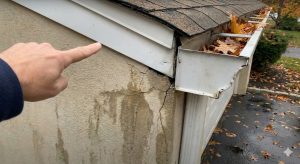
- Dark Stains Under Windows: often called “stucco tears.” If you see dark streaks running down from the corners of windows, it usually means water is getting behind the frames.
- Green Algae or Mold: While surface dirt is normal, localized green patches often indicate a constant moisture source that isn’t drying out.
- Cracks Wider than a Credit Card: Hairline cracks are normal for traditional hard-coat stucco. However, cracks wider than 1/16th of an inch (about the thickness of a credit card) are open doors for water intrusion.
- Stucco Touching the Ground: This is a major code violation. There should be a gap of at least 4–6 inches between the bottom of the stucco and the soil. If the stucco is buried in the earth, it acts like a wick, pulling moisture up and inviting termites.
2. The #1 Culprit: Missing “Kick-Out” Flashing
If you only check one thing, check this.
What is it? Kick-out flashing is a small, angled piece of metal located where a roof line ends against a vertical wall. Its job is to “kick” the rainwater into the gutter and away from the wall.
Why it matters: Without this $20 piece of metal, gallons of roof runoff pour directly down the side of your stucco wall every time it rains. In NJ/PA, this is the leading cause of major structural rot. If you look up and don’t see this metal diverter, assume there might be damage below.
3. Windows and Doors: The Caulk Check
Stucco itself is essentially waterproof (especially acrylic finishes). The leaks almost always happen at the transitions—where the stucco meets windows and doors.
Check the sealant (caulking) around these frames.
- Is it missing?
- Is it dried out, cracked, or pulling away?
If the seal is broken, wind-driven rain will get behind the system. JARART LLC specializes in proper silicone sealing (using top brands like Pecora and Dow), which is often all that is needed to prevent future issues.
4. The EIFS Question: Is “Synthetic Stucco” Safe?
If the house was built in the 1990s with EIFS (Exterior Insulation and Finish System), your home inspector might flag it.
In the past, older “barrier” EIFS systems lacked a way for water to drain if it got behind the foam. Modern EIFS (which we install today) has sophisticated drainage channels.
- Don’t panic: Just because it is EIFS doesn’t mean it’s bad.
- Do test: With EIFS, a professional moisture inspection is non-negotiable.
5. When to Call the Pros: Invasive Moisture Testing
A general home inspector will do a visual check, but they often cannot tell you if the wood behind the stucco is wet.
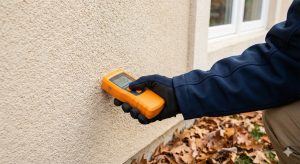
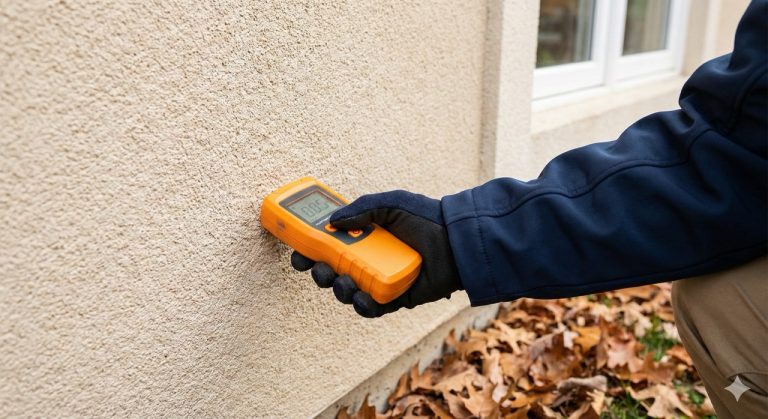
For peace of mind, we recommend a Stucco Moisture Inspection. This often involves “invasive probe testing”:
- Drilling two tiny holes (smaller than a pencil tip) under key windows.
- Inserting a moisture meter to test the firmness and moisture content of the substrate (plywood/OSB).
- The Metrics:
- Below 12%: Healthy, dry wood.
- 12% – 19%: Elevated moisture, warrants investigation.
- Above 20%: Soft/rotting wood. Professional repair is required.
Note: The tiny holes are sealed immediately with color-matched sealant and become invisible.
Found an Issue? Here is Your Next Step.
Discovering a crack, missing flashing, or high moisture reading doesn’t mean you shouldn’t buy the house. It simply means you need leverage for negotiation.
You have two options:
- Ask the seller to fix it before closing (Risky – they might choose the cheapest “band-aid” fix).
- Get a professional repair estimate and deduct it from the home price (Recommended).
This is where JARART LLC comes in. We don’t just inspect; we provide solutions. Whether it is retrofitting kick-out flashings, sealing windows, repairing cracks, or replacing damaged sections with seamless color matching, we restore the integrity of the home.
Buying a home is a big decision. Ensure your investment is dry and secure.
Contact JARART LLC for a Consultation or Repair Estimate. 📞 Call: (609) 375 7155 📍 Serving: New Jersey & Pennsylvania