EIFS vs Traditional Stucco: How to Tell What You Have and Why It Matters
The important question is not whether you have EIFS or traditional stucco. It is whether your EIFS was built with a drainage path behind it — because that single detail separates a system that performs for decades from one that quietly rots the wall it’s attached to.
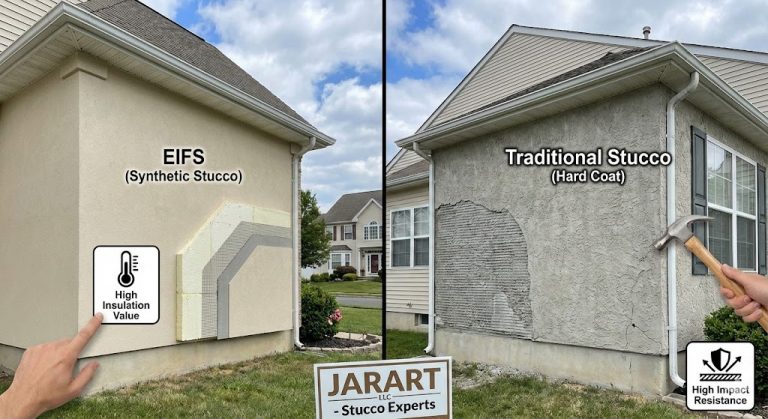
EIFS stands for Exterior Insulation and Finish System — the EIFS meaning in plain terms is rigid foam insulation attached to the sheathing, covered with a reinforced basecoat and an acrylic finish. It is often called EIFS stucco or synthetic stucco. Traditional stucco is cement plaster applied over metal lath. They can look identical from the street. The difference in how they handle water is the reason one of them has a reputation problem.
If you are trying to work out what is on your house and whether it should worry you, this guide is built around that question rather than around specifications. Manufacturers publish excellent technical material on EIFS; what they have less reason to write is what a homeowner with a 1997 installation should actually do.
The Distinction That Actually Matters
Most comparisons frame this as stucco vs EIFS. That framing hides the more important split, which is within EIFS.
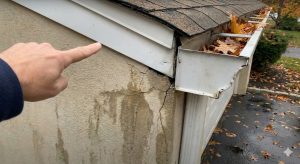
Barrier EIFS, also called face-sealed, was designed to be watertight at the surface. There is no drainage path behind the foam. The theory was that if nothing gets in, nothing needs to get out. In practice water always finds a way past sealant joints and window transitions eventually, and once behind the foam it had nowhere to go. Building Science Corporation describes face-sealed EIFS as inherently defective and unfit for use where moisture-sensitive components sit behind it without provision for drainage, and the National Association of Home Builders has taken a comparable position.
Drainable EIFS, sometimes called a water-managed EIFS system, adds a drainage plane between the foam and the sheathing so water that gets in can exit. It was introduced in the mid-1990s specifically to solve this, and the industry association recommended the switch for residential construction in 1998. Drainable EIFS installed and detailed correctly is a genuinely good system — it is the only common cladding that provides continuous insulation across the wall.
The gap between barrier and drainable EIFS is far wider than the gap between drainable EIFS and traditional stucco. A homeowner told “you have EIFS, that’s bad” has been given an incomplete answer. The correct question is which kind, and roughly when it was installed.
How to Tell What You Have
Whether you call it EIFS siding, synthetic stucco or an EIFS exterior, you can narrow down what you have yourself before calling anyone.
- Press the wall firmly somewhere inconspicuous. Traditional hard-coat stucco feels like stone and does not move. EIFS gives very slightly and sounds hollow when tapped — you are feeling foam.
- Look at an exposed edge — a window return, or where a wall meets a soffit. The substrate is often visible there. Foam is unmistakable once you see it.
- Check the year the house was built. This is the single most informative data point. EIFS on a house from the 1980s or early-to-mid 1990s is most likely barrier type. Later than the late 1990s and it is more likely drainable.
- Look for weep details at the base of the wall. Drainable systems need somewhere for water to exit at the bottom of the assembly. Their presence is a good sign; their absence on a suspected EIFS wall is not conclusive but is worth noting.
Where this narrowing leaves genuine doubt — and on a pre-1998 house it usually does — moisture testing settles it. What a stucco inspection involves is covered here.
The construction date narrows the odds, it doesn’t settle them. Plenty of builders carried on using barrier systems after drainable was available, because it was cheaper and they knew it. And some careful builders were detailing for drainage before it became standard. Use the year to decide how urgently to look — not to conclude you’re fine.
EIFS vs Stucco, Head to Head
Assuming a properly detailed drainable system, here is how the two compare on the things that affect a homeowner:
| Traditional hard coat | Drainable EIFS | |
|---|---|---|
| Insulation value | Essentially none | Continuous across the wall |
| Impact resistance | High — cement over lath | Low — foam dents |
| Crack resistance | Moderate — rigid, cracks with movement | High — acrylic finish flexes |
| Weight on structure | Heavy | Light |
| Woodpecker damage | Not vulnerable | Vulnerable — a real problem in this region |
| Track record | Over a century | Roughly three decades for drainable systems |
| Repair complexity | Well understood | Requires system-specific materials and method |
In New Jersey and eastern Pennsylvania the climate pushes on both. Roughly 90 to 110 freeze-thaw cycles a year work on cracks in hard coat; over 45 inches of annual rain, much of it wind-driven, tests transitions on both systems equally. Neither is disqualified by the climate. Both depend entirely on their flashing details.
Why Insurers Treat EIFS Differently
This comes up constantly and is rarely addressed honestly, because the people who write most EIFS content sell EIFS.
Some carriers decline to write policies on homes with EIFS at all. Others will cover them only where the system is drainable, or apply specific exclusions. The reason is the claims history from the barrier era — widespread hidden moisture damage, expensive to remediate, and difficult to attribute cleanly to a single covered event.
That last point is the crux. Standard homeowners policies cover sudden and accidental damage. Water that has been getting past a window transition for years is classified as gradual damage, faulty workmanship, or a maintenance issue — all standard exclusions. Mould arising from gradual intrusion is typically excluded too, or capped well below the cost of the work.
The practical implications if you have or are buying an EIFS home: check with your carrier specifically rather than assuming your policy behaves normally, be able to say whether the system is barrier or drainable, and understand that documentation from an inspection strengthens your position considerably if you ever do need to make a claim. More on the insurance picture around remediation here.
We’re contractors, not insurance advisers. Policies differ and this is general context, not advice on yours. Read your own policy language on water damage, faulty workmanship and mould, and talk to your carrier about your specific situation.
If You Have Older EIFS, What Are the Options?
Three realistic paths, and the right one depends on what testing finds rather than on the age alone.
| Situation | Reasonable response |
|---|---|
| Barrier EIFS, testing shows dry | Monitor and maintain — sealant and flashing upkeep becomes non-optional. Retest periodically. |
| Isolated elevated readings at specific openings | Targeted EIFS repair — correct the transition, replace affected material, restore the finish. |
| Widespread moisture or confirmed sheathing damage | Remediation — strip affected elevations, rebuild with drainage and correct flashing. |
Whichever path you take, use EIFS contractors who work with the system routinely — an EIFS installer needs system-compatible materials and method, and general stucco technique does not transfer. Worth knowing: remediation of a barrier EIFS wall does not mean you must abandon EIFS. Rebuilding with a modern drainable system keeps the insulation benefit while fixing the flaw that caused the failure. Switching to hard coat, cement board or another cladding entirely is also an option — the comparison against other exteriors is here. What matters far more than the material is that the assembly behind it drains.
Frequently Asked Questions
Originally from Poland, Kamil spent years mastering stucco and exterior finishing before founding JARART LLC in New Jersey. Over a decade of NJ and PA projects — from Mercer County residences to commercial work for Marriott and Hyatt and the BAPS Swaminarayan Akshardham Temple in Robbinsville, NJ, the largest Hindu temple in the USA. JARART LLC works with Senergy-Sika, Dryvit, Sto, Sherwin-Williams, Behr, Pecora and Benjamin Moore materials.